Every year, about 1 million people become US citizens. This big change happens through a long process. It takes 8 to 12 months for most people.
There are many ways to become a US citizen. The most common is to live here legally for five years. To become a citizen, you need to know a lot and be ready to commit.
To become a citizen, you must meet certain rules. You need to pass background checks and speak English well. You also have to know a lot about the US. This shows you’re ready to be part of America.
Table of Contents
Key Takeaways
- Approximately 1 million people are naturalized annually in the United States
- The average naturalization process takes 8 to 12 months
- Permanent residency is typically required for five years before applying
- 60% of applicants pass the civics test on their first attempt
- Online applications can reduce processing times significantly
Introduction to US Citizenship
Becoming a US citizen is a big step. It opens doors to new chances and rights. For green card holders, it’s a journey to fully join American society.
The citizenship process welcomes those who want to live by American values. It’s important to know the rules for this journey.
Overview of the Citizenship Process
Naturalization is the main way for foreign-born people to become US citizens. The process includes:
- Being at least 18 years old
- Maintaining lawful permanent resident status for specific periods
- Demonstrating continuous residence in the United States
- Passing background and security checks
Importance of Citizenship
Getting US citizenship brings many benefits:
| Benefit | Description |
|---|---|
| Voting Rights | Participate in national and local elections |
| Federal Employment | Eligible for government jobs |
| Protection | Guaranteed constitutional rights and protections |
| Travel | Obtain a US passport and easier international travel |
Permanent residents must wait 5 years to apply for citizenship. Some, like spouses of US citizens or military, can apply after 3 years.
Pathways to US Citizenship
Becoming a US citizen has many ways. Each way fits different people’s needs. The US has several legal ways to get citizenship. Each way has its own rules and time frames.
Naturalization Process for Permanent Residents
The naturalization way is very common. To qualify, you need to:
- Be a lawful permanent resident for at least 5 years
- Demonstrate continuous US residency
- Pass English language and civics tests
- Show good moral character
Citizenship through Parents
Some people get citizenship through their parents. Jus soli and jus sanguinis are two ways. They are for those with US citizen parents.
Consular Processing for Overseas Applicants
People living abroad can apply through consular processing. This way lets some immigrants apply from outside the US. It makes getting citizenship easier.
| Citizenship Pathway | Average Processing Time | Key Requirements |
|---|---|---|
| Naturalization | 12-18 months | 5 years permanent residency |
| Citizenship by Parents | 6-12 months | Parental US citizenship |
| Consular Processing | 10-24 months | Overseas application |
It’s important to know your situation well. Talk to immigration experts. They can help find the best way for you.
Eligibility Requirements for Citizenship
To become a US citizen, you must know the rules. You need to show you’re ready to join the country. This means meeting certain requirements.
General Eligibility Criteria
First, you must meet basic needs:
- Be at least 18 years old
- Show good moral character
- Pass background checks
- Be a lawful permanent resident
Residency Requirements
The test checks if you’ve lived in the US long enough:
- For non-married applicants: Five years of permanent residency
- For those married to US citizens: Three years of permanent residency
- Live in the US without long trips abroad
- Be physically in the US for at least 30 months
English Language Proficiency
You must show you can speak English well:
- Read English well
- Write English well
- Talk and understand English
- Pass a test on US history and government
Knowing these rules helps you get ready for citizenship. Preparing well makes the process easier.
Steps in the Naturalization Process
Getting US citizenship is a big journey. It has many steps. Knowing how long it takes and what you need is key.
Getting US citizenship takes time and effort. You need to meet certain rules and go through several steps.
Completing Form N-400
The Form N-400 is your application for citizenship. You’ll need to share lots of personal info, like:
- Personal background details
- Residential history
- Employment information
- Immigration status documentation
Biometrics Appointment Process
After you send in your Form N-400, you’ll get a biometrics appointment. Here, you’ll:
- Give your fingerprints
- Have a background check
- Show who you are
Naturalization Interview Preparation
The naturalization interview is very important. To get ready, you should:
- Learn about US history and civics
- Practice speaking English
- Get all your documents ready
| Process Stage | Estimated Time | Key Requirements |
|---|---|---|
| Form N-400 Filing | 1-2 weeks | Complete application accurately |
| Biometrics Appointment | 2-4 weeks after filing | Bring valid identification |
| Interview Scheduling | 6-12 months | Prepare documentation |
| Final Decision | 1-2 months after interview | Pass civics and language tests |
Pro tip: Keep good records and get help from experts to make your citizenship process easier.
Processing Time for Form N-400
Understanding the citizenship waiting period and US citizenship rules is key. The Form N-400 is important in the naturalization process. Its processing times can vary a lot.
Right now, the Form N-400 processing time is between 7 to 10 months. Several things can affect how long it takes to process your application.
Average Processing Timelines
The time it takes depends on many factors. USCIS gives estimated times on their website. This lets you check your application’s status.
| Filing Method | Processing Time | Filing Fee |
|---|---|---|
| Paper Filing | 7-10 months | $760 |
| Online Filing | 7-10 months | $710 |
Factors Affecting Processing Times
- USCIS office location
- Completeness of application
- Background check complexity
- Additional documentation requirements
To speed up your application, follow these tips:
- Submit all required documentation
- Provide accurate personal information
- Respond quickly to any USCIS requests
- Ensure tax transcripts for the past 5 years are included
Remember, you can file early, up to 90 days before the needed residency period. This might make the citizenship waiting period shorter.
Biometrics Appointment
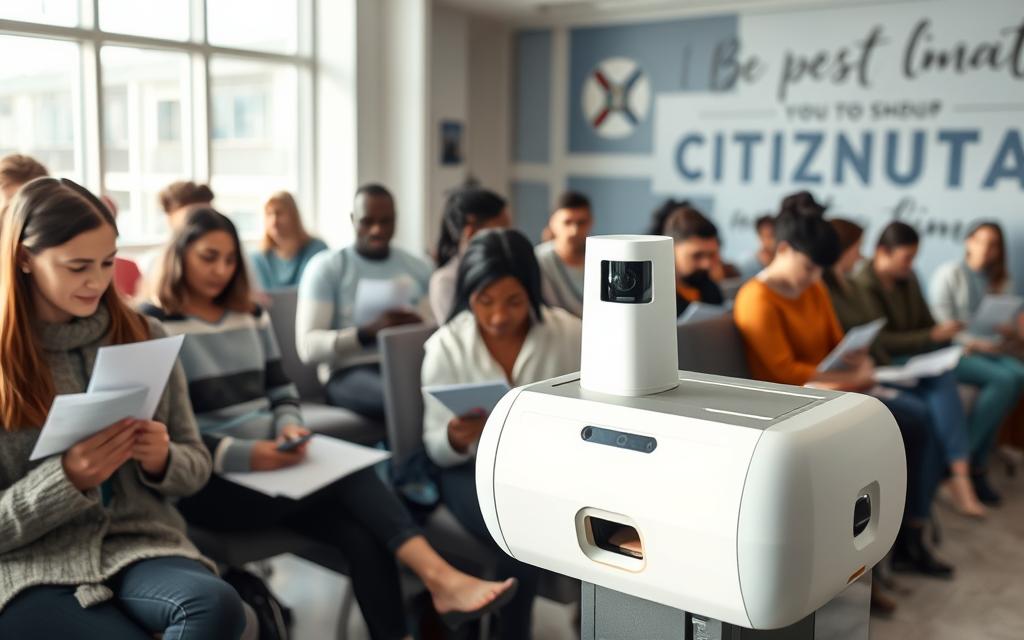
The biometrics appointment is a key part of applying for citizenship. It’s a step in the US naturalization process. It helps check who you are and do background checks.
At the biometrics appointment, you give important personal info. You will do:
- Digital fingerprinting
- Photograph capture
- Signature verification
- Comprehensive security screening
What to Expect During Your Appointment
USCIS will send you a notice with details about your biometrics session. Preparation is key to a smooth experience. You should arrive early and bring needed documents, like:
- Appointment notice
- Valid government-issued photo ID
- Green Card
- Passport (if applicable)
Timeline and Processing
The biometrics appointment happens 5-8 weeks after you file your documents. It’s quick, lasting 10-15 minutes. USCIS checks your fingerprints against FBI databases and security watchlists.
Showing up is very important. Missing it can cause big delays or even stop your citizenship application. The info you give helps move you forward in the immigration process.
The Naturalization Interview
The naturalization interview is a big step on the way to becoming a US citizen. USCIS officers check if you’re ready to be a citizen. Knowing what to expect can make you feel more ready.
Preparing for the Interview
Getting ready is very important for the naturalization interview. You should:
- Gather all needed documents
- Practice speaking English
- Learn about US history and civics
- Review your immigration story
Understanding the Interview Components
The interview has two main parts:
- English Language Test
- They check how well you speak
- How well you read
- How well you write
- Civics Test
- 10 questions from 100 topics
- You need to answer 6 right
- You get two chances
Interview Statistics and Insights
| Interview Aspect | Details |
|---|---|
| Average Interview Duration | Less than 30 minutes |
| Scheduling Timeframe | 3-5 months after Form N-400 filing |
| Retesting Opportunity | 60-90 days after first interview |
Be well-prepared for the naturalization interview. It’s a big step to becoming a US citizen. Stay calm, organized, and know your stuff to do well.
Taking the Oath of Allegiance
The final step in becoming a US citizen is very special. It changes an immigrant into a full-fledged United States citizen. The Oath of Allegiance is the end of a hard journey, showing a big change in a person’s life and law.
Understanding the Oath of Allegiance
The Oath of Allegiance is a promise new citizens make to the United States. At the naturalization ceremony, they say they will be loyal and support the country’s values and laws.
- Renounce allegiance to foreign governments
- Pledge to support and defend the US Constitution
- Commit to the legal and civic responsibilities of citizenship
Significance of the Ceremonial Moment
Most US citizenship applications get approved. The Oath of Allegiance ceremony is the last big step. People from all over come together to change their legal status, showing the country’s diverse culture.
Ceremony Preparation and Expectations
Before the ceremony, applicants must do a few things:
- Submit Form N-445, Notice of Naturalization Oath Ceremony
- Bring required documents
- Surrender Permanent Resident Card
- Pass final check by USCIS officers
The ceremony usually takes a few hours. Court security checks everyone. Guests can come, but there might not be enough seats. This makes the ceremony very special and emotional for new citizens.
Potential Delays in the Naturalization Process
Becoming a US citizen is a complex journey. Green card holders might face unexpected delays. This can make their path to citizenship longer.
Knowing the citizenship rules and common issues can help. It can reduce the chances of delays in the naturalization process.
Common Reasons for Delays
- Incomplete Application: Missing or wrong documents can slow things down a lot
- Background check problems
- Not enough proof of living in the US
- Review of criminal history
- Challenges with English and civics tests
How to Address Delays
- Check your application carefully before sending it
- Answer USCIS quickly if they ask for more info
- Work hard on English and civics tests
- Keep your immigration records up to date
- Get legal help if you hit a snag
The naturalization process usually takes 8 to 12 months. Be ready for delays and stay patient.
Here are some tips to avoid delays:
– Make sure your application is complete and right
– Give all needed documents
– Study hard for English and civics tests
– Keep living in the US as required
Delays can be tough, but knowing what might happen helps. It makes the journey to becoming a US citizen smoother.
Citizenship for Permanent Residents
Becoming a U.S. citizen is a big deal for permanent residents. The journey to citizenship application lets them join American society fully.

Permanent residents can become citizens through a set timeline. They must meet certain rules to qualify:
- Maintain lawful permanent resident status for at least 5 years
- Demonstrate continuous residence in the United States
- Prove good moral character
- Pass English language and civics tests
Benefits of Permanent Residence
Permanent residents get many benefits before becoming citizens. They can live and work in the U.S. forever. They also get U.S. law protection and access to social services.
Transitioning to Citizenship
The naturalization process has important steps. Applicants must fill out Form N-400, go to an interview, and pass background checks. In fiscal year 2024, 83.8% of naturalized citizens were long-term permanent residents who had lived in the U.S. for at least 5 years.
Permanent residents should know the naturalization rules well. They should also prepare well for the citizenship journey. With hard work and planning, becoming a U.S. citizen can be very rewarding.
Citizenship for Military Members
The US immigration law has special ways for military members to get citizenship. These paths make it easier to become a US citizen.
Military folks can get citizenship through two main parts of the Immigration and Nationality Act (INA). These parts help active-duty service members and veterans become US citizens.
Eligibility for Active Duty Armed Forces
To get military-based naturalization, service members need to meet certain rules:
- Be at least 18 years old
- Serve honorably for a minimum of one year
- Demonstrate good moral character
- Pass background security checks
Accelerated Naturalization Process
The naturalization process for military members has great benefits:
| Benefit | Details |
|---|---|
| Application Fees | Waived for military service members |
| Residency Requirements | Significantly reduced or eliminated |
| Processing Time | Expedited (6-12 hours per recruit) |
Military folks can apply for citizenship while serving. This is true for those serving in special times of war. The program has helped members from over 53 countries become US citizens.
Service members wanting citizenship should start by filling out Form N-400 and Form N-426. The whole process usually takes about eight weeks. They must show they can speak English and pass a civics test.
Dual Citizenship in the US
Dual citizenship is complex and has its own rules. About 9 million U.S. citizens have it. This shows more people are moving around the world and connecting with different cultures.

The U.S. has its own way of handling citizenship. Before 1967, having two citizenships was not allowed. But now, the U.S. Supreme Court says people can have citizenship in more than one country.
Understanding Dual Citizenship Basics
Dual citizenship means you can be a citizen of the U.S. and another country at the same time. Important things to know include:
- More than 70 countries recognize dual citizenship.
- About 25% of immigrants to the U.S. have dual nationality.
- Rules vary by country.
Rights and Responsibilities
Dual citizens get special benefits but also face big legal challenges:
- They can vote in both countries.
- They might have to pay taxes in both places.
- They need to think about military service.
- They can own property in both countries.
The master nationality rule means the U.S. only sees U.S. nationality. About 30 countries let you have dual citizenship with the U.S. But, each country has its own rules for who can have it.
Knowing these details helps people make smart choices about having more than one citizenship. It helps them follow the law and take advantage of new opportunities.
Citizenship for Spouses of US Citizens
The journey to citizenship for spouses of US citizens is special. It’s important to know the rules and steps for those married to Americans.
Spouses of US citizens get to wait less time for citizenship. This makes the naturalization process easier for those in marriage-based cases.
Application Process for Spouses
To start the citizenship journey, spouses need to meet certain criteria:
- Be a lawful permanent resident
- Have been married to a US citizen for at least 3 years
- Demonstrate continuous residence in the United States
- Prove good moral character
Timeframe for Spousal Applications
The naturalization process for spouses has key steps:
| Stage | Typical Duration |
|---|---|
| Form N-400 Processing | 8-14 months |
| Biometrics Appointment | 4-6 weeks after filing |
| Citizenship Interview | 6-12 months after filing |
| Oath Ceremony | 1-2 months after interview |
Spouses also need to prove their marriage is real and meet all USCIS rules. In 2022, the US welcomed 967,500 new citizens. Many came through marriage.
Applicants must file Form I-130 to show their relationship. The process takes patience, good documents, and a deep understanding of US citizenship rules.
Impact of Criminal History on Citizenship
Getting US citizenship can be tough for people with a criminal past. It’s important to know how past legal troubles can affect your application.
Criminal records can really affect your journey to becoming a US citizen. You must show you have good moral character for the last five years before applying.
Disqualifying Offenses
Some crimes can stop you from getting US citizenship. These include:
- Murder
- Aggravated felonies
- Crimes involving moral turpitude
- Drug-related offenses
Specific Criminal Impact Details
| Offense Type | Citizenship Impact |
|---|---|
| Murder | Permanent Bar |
| Aggravated Felony | Permanent Bar if sentenced after November 29, 1990 |
| Minor Drug Possession | Potential Temporary Bar (Exception for ≤30g marijuana) |
| Crimes with 180+ Days Imprisonment | Temporary Bar from Citizenship |
Waivers and Exceptions
Even with a criminal history, there are ways to move forward. You should:
- Disclose all arrests on Form N-400
- Provide documentation explaining circumstances
- Demonstrate rehabilitation
- Consult immigration legal professionals
USCIS does deep background checks. Being open and honest is key when applying for citizenship. Each case is looked at closely, based on the criminal history.
Accessing Legal Assistance
US citizenship laws can be hard to understand. Many immigrants need help to get citizenship. Knowing when to ask for legal help is very important.
When to Seek Legal Help
Legal help is needed in many situations:
- Complex immigration history
- Prior criminal records
- Extended periods outside the United States
- Complicated family immigration situations
- Multiple visa status changes
Resources for Immigration Assistance
There are many ways to get affordable legal help:
| Resource Type | Description | Cost |
|---|---|---|
| Community Clinics | Local workshops providing immigration guidance | Free/Low-cost |
| Non-Profit Organizations | Specialized immigration legal services | Sliding scale fees |
| Pro Bono Legal Services | Free legal representation for qualifying individuals | Free |
When looking for legal help, check their credentials. Make sure they are accredited immigration attorneys or known for citizenship help. Stay away from unauthorized people who could harm your application.
FAQs about US Citizenship
Getting US citizenship can be tricky. Many people have questions about how to do it. The United States Citizenship and Immigration Services (USCIS) handles about 1 million applications each year. Over 80% of these are approved.
It’s important to know about US immigration and citizenship rules. This helps those who want to apply.
Common Citizenship Questions
Many wonder how long it takes to get US citizenship. The process usually takes 18 to 24 months. Form N-400 takes 8 to 12 months to process.
More than 90% of people pass their tests on the first try. You need a Green Card for five years (or three if married to a U.S. citizen). You must also live in the U.S. continuously.
Resources for More Information
There are many places to get help. Official USCIS resources, immigration lawyers, and local centers can guide you. In 2022, 77% of applicants were from Central and South America.
The average age of applicants is 40. You’ll need to prepare documents and pass background checks. This includes fingerprinting and FBI screenings.